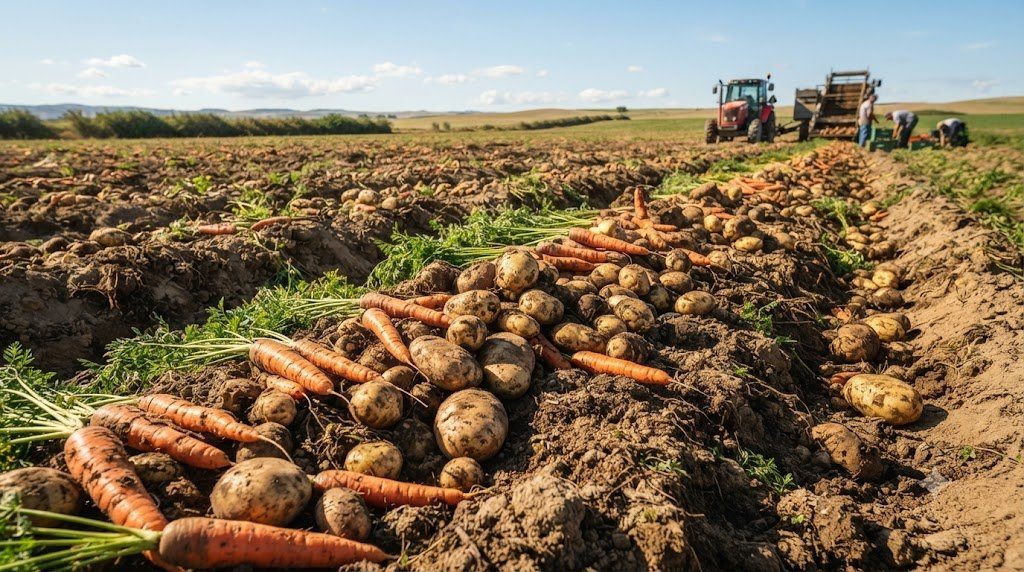
Underground Wealth: Botanical Diversity of Edible Roots and Tubers
Root and tuber crops represent the primary underground caloric reserves, complex carbohydrate storehouses, and vital micronutrient factories of world agriculture. Among the most economically dominant and widely cultivated representatives of this subterranean domain are the potato (Solanum tuberosum L.), carrot (Daucus carota L. subsp. sativus), and radish (Raphanus sativus L.). While popularly lumped together as ‘root crops’ in culinary parlance, these species represent profoundly distinct botanical structures, developmental origins, and evolutionary specializations spanning three separate plant families:
- Potato (Family Solanaceae): The edible potato is not a root at all; it is an enlarged Modified Underground Stem Tuber produced at the swollen terminus of a specialized plagiotropic underground stem called a Stolon. As a stem, the potato tuber possesses true nodes (‘eyes’) featuring axillary buds, scale-like leaf scars, and internal vascular rings.
- Carrot (Family Apiaceae / Umbelliferae): The edible carrot is a true Enlarged Storage Taproot combined with an upper hypocotyl core. Domesticated in Central Asia and the Near East, carrots are biennial root crops prized for their massive accumulation of dietary carotenoids (chiefly alpha- and beta-carotene) stored within fleshy root phloem parenchyma.
- Radish (Family Brassicaceae): The radish is a fast-cycling cool-season crop whose swollen edible fleshy organ is formed by the coordinated anatomical enlargement of both the Hypocotyl and Upper Taproot Axis, enriched with pungent sulfurous isothiocyanates.
In this agronomic and physiological monograph, we analyze the systemic hormonal signals (the SP6A tuberigen) governing potato tuberization, evaluate soil physical friability and ridge architecture, model linear bulking kinetics, explore secondary growth defects (forking, cracking, and hollow heart), deconstruct late blight (Phytophthora infestans) epidemiology, and establish long-term cold storage dormancy preservation protocols.
‘In the potato plant, the physiological transition from stolon elongation to underground tuber swelling is triggered by a mobile systemic flowering-locus-T homolog protein known as SP6A—The Tuberigen! Synthesized in the leaves under short photoperiods and cool night temperatures (< 18°C / 64°F), SP6A is loaded into the phloem and translocated downward into underground stolon tips, where it complexes with transcription factors to arrest stolon elongation and trigger radial cell division and massive starch deposition.'
Potato Tuberization: The Stolon-to-Tuber Transition and Bulking Phases
The developmental lifecycle of the commercial potato crop progresses through five strictly coordinated physiological stages:
- Sprout Development and Emergence (Stage I): Energy is drawn exclusively from seed tuber mother starch reserves. Underground eyes sprout, pushing shoots toward the soil surface while developing basal adventitious roots.
- Vegetative Canopy Expansion (Stage II): Active photosynthesis begins. Leaves, stems, and plagiotropic underground runners—Stolons—elongate from basal stem nodes beneath the soil surface. High nitrogen during this stage builds the photosynthetic leaf area index (LAI 4.0 to 6.0).
- Tuber Initiation / Tuber Hooking (Stage III): Stolon tips cease longitudinal elongation and swell into a hooked shape. Sub-apical stolon cells divide radially and accumulate patatin storage proteins. This stage occurs roughly 30 to 45 days after emergence and requires cool night temperatures (12°C to 18°C). Elevated night temperatures (> 22°C / 72°F) shut down SP6A synthesis, completely blocking tuber initiation!
- Linear Tuber Bulking (Stage IV): The primary yield-building sprint lasting 40 to 70 days. Sucrose translocated from the canopy is converted into amylose and amylopectin starch granules inside tuber amyloplasts. Under optimal conditions, a high-yielding potato stand bulks dry matter into tubers at rates of 800 to 1,200 kg per hectare per day!
- Tuber Maturation and Skin Set (Stage V): Canopy begins natural senescence. Photosynthate translocation ceases; dry matter stabilizes (18% to 22% specific gravity), and the outer periderm undergoes Suberization (Skin Set), converting the delicate skin into a tough, scratch-resistant protective bark.
| Crop Species | Morphological Structure | Critical Soil Depth | Optimal Bulking Temp | Major Soil Impedance Defect | Key Quality Metric |
|---|---|---|---|---|---|
| Potato (Solanum tuberosum) | Modified underground stem tuber (stolon) | 15 – 25 cm (Raised loose ridges) | 16°C – 20°C (Soil temp) | Tuber flattening, compaction scabs, greening | Specific gravity (Dry matter % > 20%), low sugars |
| Carrot (Daucus carota) | Enlarged taproot + hypocotyl core | 25 – 35 cm (Deep stone-free beds) | 15°C – 18°C (Cool climate) | Root forking, fanging, split roots, cavity spot | Total carotenoids (beta-carotene), crisp coreless flesh |
| Radish (Raphanus sativus) | Swollen hypocotyl and upper root axis | 15 – 20 cm (Friable raised beds) | 12°C – 18°C (Fast 25-45 day cycle) | Pithiness, hollow root, woody secondary xylem | Turgid, crisp, pungent flesh without internal sponge |
| Sweet Potato (Ipomoea batatas) | Adventitious storage root (Convolvulaceae) | 20 – 30 cm (Warm sandy ridges) | 22°C – 28°C (Warm tropical) | Skin cracking, misshapen crooked roots | High beta-carotene or anthocyanin, high starch |
| Beetroot (Beta vulgaris) | Hypocotyl and taproot globose tuber | 15 – 25 cm (Neutral loams) | 15°C – 19°C (Uniform moisture) | Internal black spot (Boron lack), ring banding | Deep betalain pigment, soluble solids (°Brix 8-12%) |
Soil Friability, Ridge Engineering, and Compaction Biomechanics
Unlike above-ground cereals and fruits whose harvestable organs expand freely in ambient air, root and tuber vegetables must expand against Physical Soil Mechanical Impedance:
- The Soil Compaction Barrier: If soil bulk density exceeds 1.35 to 1.45 g/cm³, or if soil penetration resistance surpasses 1.5 to 2.0 MPa, expanding roots and tubers cannot displace soil particles:
- Carrot Forking and Fanging: The delicate elongating taproot tip strikes a compacted plow pan, gravel stone, or hard clod. The primary root meristem dies or bifurcates, sending out multiple crooked, twisted lateral roots (‘fanging’), producing grotesque, unmarketable carrots.
- Potato Deformity: Potato tubers expand radially. In hard, cloddy, compacted soils, mechanical resistance restricts uniform expansion, resulting in knobby, dumb-bell shaped, flattened tubers.
- Deep Tillage and Stone Separation: Commercial carrot and potato production utilizes specialized deep subsoilers and Rotary De-Stoning / Clod Separation Machines. These implements pulverize the top 35 cm of soil, sift out stones and hard clods, and deposit them into inter-row furrows, leaving a stone-free, cloud-like, friable raised seedbed.
- Raised Ridge / Bed Architecture: Potatoes are planted in wide, trapezoidal Raised Ridges (Hills) 75 to 90 cm wide. Raised ridges provide three indispensable agronomic advantages:
- Elevates the root zone above waterlogged furrows during torrential rains, preventing tuber asphyxiation and bacterial soft rot.
- Creates an expansive volume of loose, uncompacted soil for unrestricted radial tuber bulking.
- Provides a dense soil barrier that shields developing tubers from solar UV radiation, preventing Tuber Greening!
Tuber Greening and Glycoalkaloid (Solanine) Biosecurity
When potato tubers are exposed to light, either in the field due to shallow hilling or post-harvest on grocery shelves, a dangerous biochemical transformation occurs:
- Chlorophyll Synthesis: Sunlight penetrates the thin periderm, triggering amyloplasts in outer cortical cells to differentiate into chloroplasts. The tuber skin turns bright green due to chlorophyll accumulation. While chlorophyll itself is completely non-toxic and harmless, it serves as an unmistakable visual biomarker of an accompanying, highly toxic reaction.
- Steroidal Glycoalkaloid (SGA) Surge: Light concurrently stimulates the de novo synthesis of toxic steroidal glycoalkaloids, predominantly Alpha-Solanine and Alpha-Chaconine. These neurotoxic compounds are natural defensive anticholinesterase inhibitors that disrupt cell membranes and poison the central nervous system:
- Safe commercial consumption standard: Total glycoalkaloids must remain strictly below 200 mg per kilogram of fresh tuber weight (20 mg/100g).
- Green, light-struck tubers routinely accumulate solanine concentrations exceeding 400 to 1,000 mg/kg, causing severe gastrointestinal cramps, vomiting, diarrhea, neurological impairment, and acute food poisoning!
- Agronomic Prevention: Ensure massive, uniform hilling (earthing up) at 20 to 25 cm canopy height, burying developing stolons under 10 to 15 cm of loose soil. Post-harvest, potatoes must be handled and stored in pitch-black dark aerated rooms under sodium-vapor or green non-actinic lights.
Secondary Growth Defects: Hollow Heart, Growth Cracks, and Cavity Spot
Subterranean organs are acute reflections of environmental and nutritional stability:
- Potato Hollow Heart: A non-parasitic internal physiological disorder characterized by an irregular star-shaped or lens-shaped brown dead cavity in the center of the tuber pith. Caused by Sudden Fluctuations in Soil Moisture and Nitrate following a period of environmental stress. Rapid cell expansion in the outer storage parenchyma outpaces nutrient translocation to the center, causing interior cells to tear apart and die. Maintaining uniform drip irrigation and avoiding excessive mid-season nitrogen surges eliminates hollow heart.
- Carrot Growth Cracking and Splitting: Sudden heavy rainfall or deep irrigation following a severe summer drought causes the inner core xylem of the carrot root to absorb water rapidly, expanding faster than the outer phloem rind can stretch. The root bursts open longitudinally along its entire length, ruining marketability.
- Carrot Cavity Spot (Pythium violae / P. sulcatum): Manifests as small, sunken, elliptical horizontal lesions on the carrot root surface. Thrives in poorly drained, water-saturated soils; applying metalaxyl-M at seeding and maintaining open soil drainage mitigates disease outbreaks.
Late Blight (Phytophthora infestans): The Historic Potato Scourge
The Irish Potato Famine pathogen, Phytophthora infestans, remains the most catastrophic biological pathogen in root and tuber agronomy:
- Epidemiology and Spore Spread: An oomycete that flourishes in cool, wet weather (15°C to 20°C with relative humidity > 90%). Leaves develop water-soaked lesions that turn dark brown to black, bordered by a delicate white ring of sporangiophores on the underside. Millions of biflagellate zoospores are washed down by rainfall through soil cracks into the ridge, infecting developing tubers and turning internal flesh into a dry, granular, reddish-brown cork rot.
- Multi-Layer Chemical Defense:
- Preventative Contact Sprays: Apply chlorothalonil, mancozeb, or fluazinam at 7-day intervals before disease appears to coat canopy foliage.
- Systemic / Translaminar Curative Chemistries: Apply cymoxanil, dimethomorph, mandipropamid, or cyazofamid immediately upon regional disease alert warnings (e.g., BlightCast models).
- Fungicide Resistance Management: Rotate FRAC groups to prevent rapid emergence of resistant clonal lineages (such as Blue 13 and EU_37_A2).
Seed Tuber Degeneration, TPS, and Tissue Culture Micropropagation
Because potatoes are traditionally propagated vegetatively using seed tubers, maintaining seed health across successive generations is a monumental challenge:
- Seed Degeneration and Viral Degeneration: Vegetatively propagated tubers accumulate debilitating systemic viruses over time—principally Potato Virus Y (PVY), Potato Leafroll Virus (PLRV), and Potato Virus X (PVX)—vectorially transmitted by aphids. With each passing clonal generation, viral titer increases, causing leaf mosaic, severe stunting, and a cumulative 40% to 60% collapse in yield potential (Seed Tuber Degeneration).
- Meristem Tip Culture and Aeroponic Mini-Tubers: Certified seed programs employ in-vitro meristem tip culture. Because the rapidly dividing apical dome (0.1 to 0.2 mm) is vascularly disconnected from the plant’s phloem, it is 100% virus-free! Cultured meristems are micropropagated in sterile laboratory media and transferred to automated Aeroponic Glasshouses, where hanging roots are misted with nutrient mist, producing pristine nuclear G0 Mini-Tubers completely free of viral and bacterial pathogens.
- True Potato Seed (TPS) Innovation: Modern hybrid breeding utilizes botanical True Potato Seed (TPS) produced from sexual berries. Just 200 grams of disease-free TPS replaces 2.5 to 3.0 metric tons of bulky, disease-prone seed tubers per hectare, revolutionizing seed logistics in remote farming regions.
Canopy Desiccation (De-Haulming), Skin Set, and Cold Storage Logistics
Harvesting long-storing root vegetables requires strict field conditioning protocols:
- Canopy Desiccation / De-Haulming: Approximately 14 to 21 days prior to harvest, the green vegetative canopy of the potato field is killed mechanically using flail mowers or chemically using contact desiccants (such as Diquat, Saflufenacil, or Carfentrazone-ethyl). De-haulming achieves three critical goals:
- Halts tuber growth, locking in target commercial size profiles.
- Prevents late blight spores on senescing foliage from washing down onto tubers.
- Forces the tuber periderm to undergo Suberization and Skin Set: the outer skin thickens and bonds tightly to underlying cortical cells. Tubers harvested without skin set suffer ‘feathering’ (skin peeling), leading to massive evaporative water loss and bacterial soft rot in storage.
- Curing Phase in Storage: Freshly harvested potatoes are cured at 15°C to 18°C with 95% RH for 10 to 14 days with high airflow. Curing allows harvest wounds and harvest scrapes to suberize and heal, erecting a protective suberin barrier against wound pathogens (Fusarium dry rot).
- Temperature Regimes and Cold-Induced Sweetening:
- Table / Fresh Market Potatoes: Cooled to 4°C to 5°C to suppress sprouting and respiration.
- Processing Potatoes (Chips and French Fries): Must be stored warmer, at 8°C to 10°C! Storing processing potatoes below 7°C triggers Cold-Induced Sweetening (CIS): starch is hydrolyzed into reducing sugars (glucose and fructose). When fried at high temperatures, reducing sugars react with free asparagine in the Maillard reaction, producing dark, bitter, burnt chips loaded with carcinogenic Acrylamide!
- Sprout Suppression: Treat storage bins with aerosolized CIPC (chlorpropham) or natural spearmint oil (carvone) to maintain bud dormancy for 9 to 11 months.
| Cropping Window | Agronomic Focus | Target Operational Action | Primary Commercial Hazard |
|---|---|---|---|
| Pre-Planting | Deep subsoiling; stone & clod separation | Till to 35 cm; construct raised friable beds/ridges | Compaction causing carrot forking and potato knobbiness |
| Planting & Emergence | Certified disease-free seed tubers / pelleted seed | Plant in moist soil at 8-10 cm depth; starter P fertilizer | Rhizoctonia stem canker; uneven emergence |
| Tuber Initiation / Bulking | Uniform drip fertigation; balanced N:K ratio | Shift N:K2O to 1:2; maintain night temp < 18°C | Hollow heart, growth cracks, low specific gravity |
| Late Season (Pre-Harvest) | De-haulming / chemical canopy desiccation | Kill vines 14-21 days before digging; verify skin set | Skin feathering, soft rot, late blight tuber infection |
| Post-Harvest Storage | Wound curing + controlled temperature holding | Cure at 15°C for 14 days; store table @ 4°C, processing @ 9°C | Cold-induced sweetening, acrylamide, sprout shrinkage |
Conclusion: The Deep Precision of Subterranean Agronomy
Root and tuber agronomy represents a sophisticated balance between below-ground physical soil mechanics and above-ground canopy physiology. By creating stone-free, friable ridge environments, managing the delicate hormonal triggers of tuber initiation, safeguarding crops against late blight and cavity spot, executing timely de-haulming for durable skin set, and maintaining strict storage temperature regimes, growers unearth extraordinary yields of subterranean wealth.
As modern precision agriculture advances with subsurface sensor networks and climate-resilient genetics, root and tuber crops will continue to anchor global food sovereignty, nourishing billions with high-energy complex carbohydrates and vital vitamins.