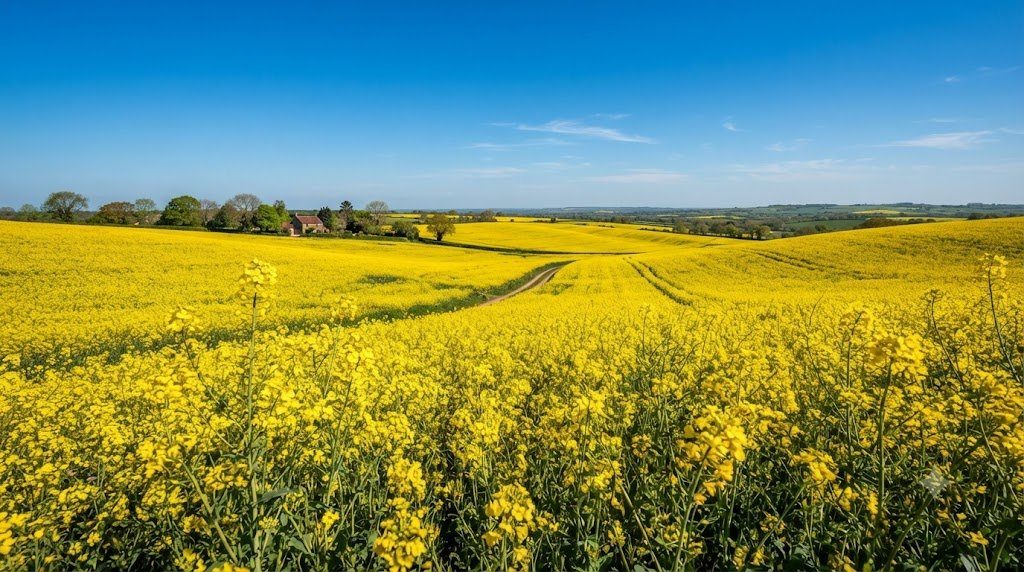
The Golden Brassicas: Botanical Foundations of Family Brassicaceae
The oilseed brassicas—collectively celebrated in global agriculture as rapeseed, canola, and mustard—represent the third most produced vegetable oil crop on earth after soybean and oil palm. Belonging to the family Brassicaceae (tribe Brassiceae), these cool-season dicotyledonous oilseeds encompass an interconnected evolutionary spectrum of diploid and allotetraploid amphidiploid species mathematically defined in 1935 by the Japanese botanist Woo Jang-choon in the famous ‘Triangle of U’:
- The Primary Cultivated Species:
- Brassica napus L. (Amphidiploid, AACC genome, 2n=38): Known internationally as Argentine canola, winter/spring oilseed rape, or swede rape. The dominant high-yielding oilseed rape across Europe, Canada, Australia, and China, boasting oil contents of 42% to 48%.
- Brassica juncea (L.) Czern. (Amphidiploid, AABB genome, 2n=36): Celebrated as Indian mustard or brown mustard. Possesses superior heat and drought tolerance, rapid early vigor, and shatter resistance, dominating the arid and semi-arid subtropical belts of South Asia.
- Brassica rapa L. (Diploid, AA genome, 2n=20): Polish canola or turnip rape. Fast-maturing with extreme cold tolerance, grown in short growing-season subarctic belts.
Historically, raw rapeseed oil was restricted to industrial lubricant and lamp fuel applications because it contained high concentrations of toxic Erucic Acid (22:1), which causes myocardial lipidosis in human cardiac tissue, while the defatted seed meal was unpalatable to livestock due to high concentrations of bitter, thyroid-enlarging Glucosinolates. The transformative triumph of modern plant breeding was the development of ‘Double-Zero’ (00) Canola Quality, which eliminated erucic acid and slashed glucosinolates, catapulting the golden brassicas into humanity’s premier heart-healthy cooking oil.
In this technical agronomic manual, we explore the cytogenetics of the Triangle of U, deconstruct the molecular breeding of Canola quality, analyze the photosynthetic biomechanics of the green Siliqua (Pod), model mustard aphid (Lipaphis erysimi) population kinetics, formulate defenses against Sclerotinia stem rot, and establish precision swathing versus direct combine harvesting protocols.
‘In the 1970s, Canadian breeders Baldur Stefansson and Keith Downey achieved an agricultural miracle by breeding the first ‘Canola’ (Canadian Oil Low Acid) varieties. To carry the certified Canola / Double-Zero (00) designation, harvested oilseed must strictly meet two regulatory biochemical standards: First, the oil must contain strictly LESS THAN 2% Erucic Acid (compared to 40-50% in traditional wild rape). Second, the solid defatted meal must contain strictly LESS THAN 30 micromoles of aliphatic Glucosinolates per gram of dry meal!’
The Triangle of U Cytogenetics and Canola Quality Breeding
The evolutionary relationships and genomic origins of the oilseed brassicas represent one of the classic triumphs of plant cytogenetics:
- The Triangle of U Architecture:
- Three basic diploid ancestral species: Brassica rapa (AA, n=10), Brassica nigra (BB, n=8), and Brassica oleracea (CC, n=9).
- Spontaneous interspecific hybridization in ancient nature, followed by natural chromosome doubling, produced three distinct allotetraploid species:
- Brassica napus (AACC, n=19) = B. rapa (AA) × B. oleracea (CC).
- Brassica juncea (AABB, n=18) = B. rapa (AA) × B. nigra (BB).
- Brassica carinata (BBCC, n=17, Ethiopian mustard) = B. nigra (BB) × B. oleracea (CC).
- The Erucic Acid Elongase Gene (FAE1): In wild brassicas, oleic acid (18:1) is elongated by the enzyme Fatty Acid Elongase 1 (FAE1) into eicosenoic acid (20:1) and ultimately Erucic Acid (cis-13-docosenoic acid, 22:1). Modern canola lines carry null-function mutations in both homologous FAE1 loci (on chromosomes A08 and C03), completely halting fatty acid elongation past 18 carbons, causing healthy oleic acid to rise to 60% to 65%!
- Glucosinolate Transporter Disruption: Glucosinolates synthesized in vegetative leaves are loaded into the phloem and imported into developing seeds by specialized Glucosinolate Transporters (GTR1 and GTR2). Canola-quality lines disrupt these transporters, trapping glucosinolates in the leaves for natural insect defense while producing clean, sweet, low-glucosinolate seed meal suitable for livestock feed.
| Species Name | Common Name | Genomic Formula (2n) | Average Oil Content (%) | Key Agronomic Superpower | Primary Production Belt |
|---|---|---|---|---|---|
| Brassica napus | Argentine Canola / Oilseed Rape | AACC (2n = 38) | 44% – 48% | Ultra-high yield potential, high oil density | Canada, EU, UK, Australia, Northern China |
| Brassica juncea | Indian Mustard / Brown Mustard | AABB (2n = 36) | 38% – 42% | Deep taproot, extreme heat & drought hardiness | India, Pakistan, Australian semi-arid zones |
| Brassica rapa | Polish Canola / Turnip Rape | AA (2n = 20) | 40% – 44% | Ultra-early maturity (80-90 days), frost escape | Subarctic Canada, Northern Scandinavia |
| Brassica carinata | Ethiopian Mustard / Carinata | BBCC (2n = 34) | 42% – 46% | Heavy biomass, high erucic acid for Aviation Biofuel | Dryland Mediterranean, US Southeast bio-diesel |
| Sinapis alba | White / Yellow Mustard | Diploid related genus | 28% – 32% | High condiment mucilage & sinalbin pungency | Condiment mustard manufacturing (US, Canada) |
The Siliqua Canopy Biomechanics: Pod Wall Photosynthesis
Crop canopy photosynthesis in oilseed rape transitions through an extraordinary developmental metamorphosis:
- The Vegetative-to-Reproductive Transformation: During vegetative rosetting and early stem elongation, broad green foliage captures solar radiation. However, as flowering completes and the bright yellow flower petals drop, nearly all vegetative leaves senesce and abscise from the lower stem!
- The Green Siliqua Layer: The mature canopy consists of thousands of slender, two-valved green fruit pods called Siliquae (Siliques) held upright in an interlocking upper canopy deck. Green siliqua walls possess high chlorophyll densities and active stomata. The green siliqua pod walls produce over 65% to 70% of the total photosynthate carbohydrates and lipids deposited into developing seeds!
- Light Interception and Reflectance: Bright yellow canola flowers actually reflect up to 60% of incident photosynthetically active radiation (PAR). Once flowering finishes and petals drop, sunlight penetrates the green pod layer, driving intense Rubisco carbon assimilation inside the outer pod pericarp until physiological desiccation begins.
Sulfur and Nitrogen Nutritional Kinetics
Brassica oilseeds have the highest sulfur requirement of any annual field crop:
- The Essential Sulfur-Nitrogen Dynamic: Brassicas require sulfur not only for protein synthesis (cysteine and methionine) but also for synthesizing sulfur-rich secondary glucosinolates and coenzyme A for lipid synthesis. A high-yielding 3.5-ton canola crop absorbs 25 to 40 kg of Sulfur per hectare.
- Sulfur Deficiency Syndrome: In sulfur-deficient soils, nitrogen cannot be metabolized into protein, causing free nitrate to accumulate. Young leaves cup upward, turn chlorotic yellow-purple, and flowers emerge small, pale white instead of rich golden yellow, setting deformed, empty, sterile siliquae!
- Application Protocol: Apply 20 to 30 kg S/ha in the plant-available Sulfate Form ($SO_4^{2-}$)—such as Ammonium Sulfate ($[NH_4]_2SO_4$) or Single Superphosphate (SSP)—at planting or early bolting. Elemental sulfur ($S^0$) must not be relied upon for in-season correction because it requires months of warm microbial oxidation to convert into sulfate. Maintain an optimum $N:S$ fertilizer ratio of 5:1 to 6:1.
Mustard Aphid (Lipaphis erysimi) Ecology and IPM
The mustard aphid (Lipaphis erysimi) is the single most destructive entomological pest of brassica crops in subtropical and warm temperate regions, capable of wiping out 50% to 90% of seed yield:
- Population Explosion Dynamics: Mustard aphids are tiny, greyish-green, wax-covered sap-sucking insects. They reproduce primarily by Thelytokous Parthenogenesis (females give birth to live, pregnant female nymphs without mating), completing a generation in just 7 to 9 days! When cool, cloudy, humid weather persists (temperatures 15°C to 20°C, RH > 75%), aphid colonies multiply exponentially, coating inflorescences, siliquae, and stems in dense, crawling crusts.
- Damage Biomechanics: Millions of piercing-sucking stylets drain phloem sap, depriving expanding siliquae of carbohydrates. Stems become stunted, pods curl into twisted sickles, seeds fail to develop, and copious honeydew excretions coat the canopy in black sooty mold (Capnodium), shutting down pod wall photosynthesis.
- Multi-Tiered IPM Arsenal:
- Early Sowing Window: Sowing Indian mustard in early to mid-October (in the Northern Hemisphere) allows the crop to complete flowering and siliqua setting before aphid immigrant swarms surge in December and January, effectively escaping peak damage.
- Economic Threshold Level (ETL): Initiate chemical or biological intervention when scouting detects 20 to 25 aphids per 10 cm terminal shoot or 10% of plants colonized during early flowering.
- Bio-Control and Biorational Chemistry: Conserve natural ladybird beetle predators (Coccinella septempunctata) and syrphid fly larvae. When ETL is breached, apply selective systemic insecticides: Dimethoate 30% EC (@ 1.0 ml/L), Thiamethoxam 25% WG (@ 0.2 g/L), or selective feeding-blockers like Pymetrozine, rotating chemical groups to prevent resistance.
Sclerotinia Stem Rot (White Mold): Sclerotinia sclerotiorum
In high-rainfall, dense canola production regions, Sclerotinia Stem Rot is the premier fungal destroyer:
- Petal-Mediated Infection Pathway: Overwintering black resting bodies (sclerotia) in the soil germinate during wet spring weather, producing tiny cup-shaped fruiting bodies called Apothecia. Apothecia forcibly eject millions of microscopic airborne ascospores into the air. Crucially, ascospores cannot infect green, healthy canola leaves directly; they require an exogenous energy source—specifically Senescing Flower Petals!
- The Infection Cascade: As the crop blooms, yellow petals senesce and fall into the lower canopy, adhering to wet leaf axils and stem branches. Ascospores germinate on the rotting petals, utilize their nutrients to build enzymatic energy, and then invade the green stem via pectinases and oxalic acid! The stem develops bleached, chalky-white lesions that girdle the stalk, causing the upper canopy to lodge, snap, and die prematurely. Splitting open the bleached stem reveals hard, black, rat-dropping-like Sclerotia.
- Targeted Bloom Fungicide Timing: Apply preventative fungicides—boscalid, prothioconazole, or fluopyram—strictly at 20% to 50% Full Bloom, before fallen petals carpet the canopy floor. Fungicide droplets must coat petals on the open flowers so that when petals fall into leaf axils, the fungal spores are sterilized.
Pod Shattering Biomechanics and Swathing vs. Direct Heading
Harvesting oilseed brassicas is a race against premature seed pod dehiscence (shattering):
- The Dehiscence Zone (DZ) Architecture: The mature siliqua consists of two pericarp valves joined along a central replum by a narrow, microscopic band of non-lignified cells known as the Dehiscence Zone. As the pod dries in the sun, differential tension develops between the lignified outer valve fibers and the non-lignified dehiscence layer. Under wind buffeting or combine impact, the valves split violently open, flinging seeds onto the ground (losing 15% to 30% of total harvestable yield!).
- Swathing (Windrowing) Mechanics:
- Traditional technique: In windy, variable climates, canola is cut with a swather and deposited into fluffy, elevated windrows resting on standing stubble at 60% Seed Color Change (SCC) on the main stem. Seeds continue maturing within the swath, protected from wind shatter, drying down uniformly for combine pickup 7 to 10 days later.
- Direct Combine Harvesting with Pod-Sealants: Modern high-yielding systems direct-combine canola standing in the field, utilizing shatter-resistant hybrids (carrying the SHP1/SHP2 mutated transcription factors) or applying synthetic latex-based Pod-Sealant Spray Adjuvants at 70% SCC. Direct heading saves $60 to $80/ha in custom swathing machinery passes.
- Post-Harvest Moisture & Safe Storage: Canola seed contains over 44% oil; high oil content makes it acutely prone to heating and spontaneous bin combustion! Seed must be dried down to 8.0% to 9.0% moisture and aerated continuously to drop bin temperatures below 15°C. Storing at 11% moisture triggers rapid respiration, fatty acid oxidation, and catastrophic bin fires within weeks.
Parasitic Weed Management: Orobanche (Broomrape) Biosecurity
In semi-arid Indian mustard and Mediterranean canola fields, the root-parasitic weed Orobanche aegyptiaca (Broomrape) represents an insidious yield killer:
- Germination Trigger: Microscopic Orobanche seeds remain dormant in the soil for over a decade. They germinate exclusively when stimulated by host root chemical exudates—specifically Strigolactones. The parasite develops a specialized haustorium that pierces the brassica root cortex, connecting directly to xylem and phloem vascular bundles to siphon off water, minerals, and carbohydrates.
- Damage and Control: Orobanche shoots emerge from the soil around the host base as fleshy, purplish-yellow, leafless spikes that flower and shed millions of dust-like seeds. Severe infestation causes 30% to 70% stunting and desiccation of the mustard crop. Control requires:
- Foliar application of low-dose systemic Glyphosate (@ 25 to 50 g a.i./ha) at 30 and 55 days after sowing. The systemic herbicide translocates down to the host roots, selectively killing the attached parasitic tubercles without killing the host mustard!
- Deep summer plowing and crop rotation with non-host trap crops (such as chickpea or wheat) that do not trigger parasite germination.
| Developmental Window | Agronomic Focus | Target Practical Protocol | Primary Yield Limiting Hazard |
|---|---|---|---|
| Seedbed Preparation | Firm, fine seedbed; shallow sowing (1.5-2.5 cm) | Band certified 00-canola seed with starter P & Sulfate | Deep planting (> 3 cm) resulting in emergence failure |
| Rosette / Bolting | Sulfur nutrition & weed suppression | Apply Ammonium Sulfate @ 100-150 kg/ha; post-emergence ALS | Sulfur starvation causing flower sterility & purpling |
| Bloom (20-30%) | Sclerotinia stem rot preventative spray | Target Prothioconazole or Boscalid spray before petal fall | Ascospore colonization on falling petals girdling main stem |
| Siliqua Development | Mustard aphid monitoring & bio-spray | Scout terminal shoots; apply Thiamethoxam if ETL reached | Aphid colonies crusting pods, curling siliquae empty |
| Harvesting Window | Swath at 60% SCC or direct-head with pod sealant | Audit seed moisture (target 8.5-9.0%); clean combine rotor | Catastrophic pod shatter losses; spontaneous bin heating |
Conclusion: The Golden Renaissance of Oilseed Brassicas
The transformation of wild, pungent rapeseed into modern, double-zero Canola and climate-hardy Indian mustard stands as one of the greatest scientific accomplishments in agricultural history. By elucidating the cytogenetics of the Triangle of U, silencing erucic acid and glucosinolate biosynthesis, optimizing siliqua pod wall photosynthesis, satisfying critical sulfur nutritional demands, and conquering destructive aphid and Sclerotinia complexes, agricultural science has endowed global humanity with a bountiful source of heart-healthy culinary oil and high-protein livestock feed.
As shatter-resistant gene-edited hybrids and sustainable aviation biofuel feedstocks expand worldwide, the golden brassicas will continue to illuminate the future of diversified, climate-smart global agriculture.