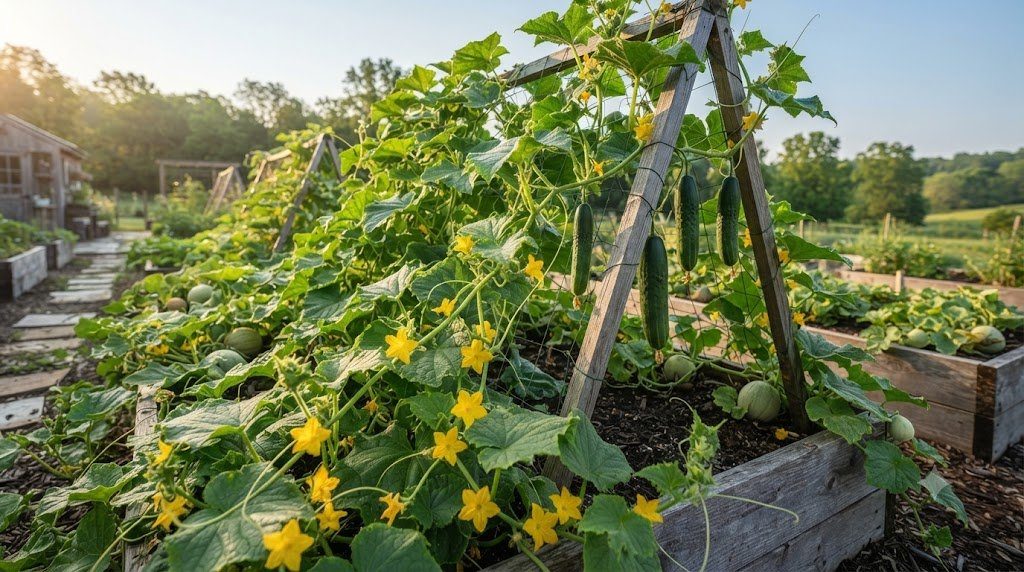
The Sprawling Vines: Botanical Architecture of Family Cucurbitaceae
The gourd family, Cucurbitaceae, constitutes one of the most genetically diverse, morphologically spectacular, and culturally cherished families in global agriculture. Encompassing over 95 genera and nearly 1,000 species, this botanical family provides humanity with an astonishing array of fresh salad crops, luscious dessert melons, and nutrient-dense cooking gourds. Among its premier commercial representatives are the cucumber (Cucumis sativus), cantaloupe and muskmelon (Cucumis melo), watermelon (Citrullus lanatus), zucchini and summer squash (Cucurbita pepo), butternut squash and pumpkin (Cucurbita moschata), and bitter gourd (Momordica charantia).
Botanically, cucurbits are prostrate, trailing, or climbing herbaceous vines characterized by pentagonal ribbed stems, branched lateral tendrils arising at leaf axils, simple palmately lobed leaves, and specialized, inferior-ovary fleshy fruits known botanically as a Pepo (a specialized berry with a tough, hard outer rind and a succulent fleshy mesocarp containing numerous flattened parietal seeds). In commercial protected greenhouses and intensive open fields, cucurbit production is an exceptionally dynamic discipline requiring deep scientific comprehension of Hormonal Sex Expression, entomophilous bee pollination kinetics, parthenocarpic fruit development, trellis vine architecture, and aggressive chemical and biological defenses against downy and powdery mildews.
In this technical treatise, we explore the ethylene and gibberellin hormonal pathways governing male-to-female sex determination, evaluate parthenocarpy in modern greenhouse Dutch cucumbers, analyze bee pollination visitation thresholds in open-field watermelons, detail vertical trellis pruning architectures, model systemic fungicide rotations against Podosphaera xanthii and Pseudoperonospora cubensis, and establish post-harvest chilling injury thresholds.
‘In monoecious cucurbits, whether an individual floral bud develops into a male (staminate) or female (pistillate) flower is not permanently locked by genetics; it is governed dynamically by endogenous plant hormones and environmental cues. High Ethylene concentrations and short photoperiods with cool temperatures stimulate the formation of female pistillate flowers bearing baby fruit ovaries. Conversely, high Gibberellic Acid (GA) levels, long daylight hours, and scorching temperatures promote an explosion of male staminate flowers—often resulting in frustrated growers observing dozens of blossoms but zero harvestable fruit!’
Hormonal Sex Expression: Monoecious, Gynoecious, and Andromonoecious Genetics
Cucurbit floral biology presents one of the most fascinating reproductive spectra in the plant kingdom:
- The Flowering Phenotypes:
- Monoecious (Traditional Wild Type): Plants bear separate male (staminate) and female (pistillate) flowers on the same individual vine. Male flowers typically appear first on lower basal nodes, followed later by female flowers on secondary and tertiary lateral runners.
- Gynoecious (All-Female Lines): Modern commercial cucumber hybrids that bear 100% female flowers at every single leaf node along the vine! Gynoecious genetics (governed by the dominant F gene) eliminate non-productive male flowers, concentrating 100% of photosynthetic energy into continuous harvestable fruit production.
- Andromonoecious: Plants bear both staminate (male) flowers and hermaphroditic (perfect) flowers containing both functional anthers and an ovary. Common in muskmelon (Cucumis melo).
- Hormonal Modulation and Environmental Triggers:
- Feminizing Factors: High endogenous Ethylene synthesis, low night temperatures (15°C to 18°C), short daylengths (8 to 10 hours), and high soil moisture upregulate the CsACS2 (1-aminocyclopropane-1-carboxylate synthase) gene, forcing primordial floral meristems to suppress stamen development and form inferior ovary pistils. Commercial growers spray Ethrel / Ethephon (2-chloroethylphosphonic acid @ 100 to 200 ppm) at the 2-to-4 true leaf stage to artificially induce high female flower counts in monoecious pumpkins and gourds!
- Masculinizing Factors: High temperatures (> 32°C / 90°F), long days (14+ hours), drought stress, and Gibberellic Acid ($GA_3$) applications suppress ethylene synthesis, causing floral primordia to develop into staminate male flowers. In hybrid seed production, breeders spray gynoecious female parent lines with silver nitrate ($AgNO_3$) or silver thiosulfate (STS)—potent ethylene action inhibitors—to force all-female plants to produce male flowers, allowing self-pollination to maintain inbred parental seeds!
| Cucurbit Crop | Botanical Classification | Sex Expression Type | Pollination Mechanism | Primary Fruit Defect | Target Harvest Stage |
|---|---|---|---|---|---|
| Greenhouse Cucumber | Cucumis sativus | Gynoecious (100% Female) | Parthenocarpic (No pollination wanted!) | Seed formation & bitterness if pollinated by bees | Immature crisp cylindrical fruit (300-400g) |
| Watermelon (Seeded) | Citrullus lanatus | Monoecious | Entomophilous (Honeybee required: 8-10 visits) | Hollow heart, bottleneck fruit from poor pollination | Dull thud sound, dry tendril, ground spot yellowing |
| Triploid Seedless Watermelon | C. lanatus (3n = 33) | Sterile female (Requires 2n pollenizer interplant) | Bees transfer 2n diploid pollen to trigger fruit set | Internal hollow heart, thick white sterile seed coats | High °Brix (> 11.5%), crisp sweet pericarp |
| Muskmelon / Cantaloupe | Cucumis melo | Andromonoecious | Honeybee / Native bee pollination | Fruit cracking from rain; low sugar (°Brix < 9.0) | Full-slip (Abscission ring separates cleanly from vine) |
| Zucchini / Summer Squash | Cucurbita pepo | Monoecious | Bombus & Squash bees (Peponapis pruinosa) | Blossom end rot, tapering fruit tip from low pollen | Immature glossy tender fruit (15-20 cm length) |
Parthenocarpy: The Greenhouse Cucumber Revolution
In high-tech greenhouse cucumber production, seed development is a severe commercial defect, resulting in tough pericarp tissue, bitter cucurbitacin accumulation, and misshapen fruit:
- The Parthenocarpic Phenomenon: Modern European slicing cucumbers and mini/Persian Beit-Alpha types possess Vegetative Parthenocarpy: the genetic ability of the unfertilized female ovary to swell, divide cells, and develop into a luscious, fully sized seedless fruit without requiring pollination or fertilization!
- Exclusion of Pollinators: Because parthenocarpic cucumbers are 100% gynoecious and develop seedless fruit spontaneously, Insect Pollinators Must Be Strictly Excluded! If a wandering honeybee enters the greenhouse carrying pollen from an open-field gourd and pollinates a parthenocarpic cucumber flower:
- Fertilization occurs, causing hard, woody seeds to develop inside the fruit.
- The fruit develops an ugly, bulbous clubbed blossom end (‘pear-shaped fruit’).
- Developing seeds stimulate bitter triterpenoid compounds (Cucurbitacins), rendering the cucumber bitter and unpalatable! Modern greenhouse growers install fine insect netting to keep bees out of parthenocarpic cucumber bays.
Pollination Ecology in Seeded Melons and Triploid Seedless Watermelons
Conversely, in open-field watermelons, squash, and muskmelons, pollination is the single most critical yield-determining event:
- Heavy, Sticky Pollen Biomechanics: Cucurbit pollen grains are large, dense, and coated with a sticky lipoidal pollenkit. Cucurbit pollen cannot be transported by the wind! Every single pollen grain must be physically transferred from the male anther to the three-lobed female stigma by foraging insects.
- The Pollination Threshold: A watermelon female flower contains roughly 1,000 to 1,200 ovules. Fully fertilizing these ovules requires a minimum of 800 to 1,000 viable pollen grains, demanding 8 to 12 separate honeybee (Apis mellifera) visits during the few morning hours (6:00 AM to 11:00 AM) that the flower remains open. If bee visits drop below this threshold:
- Only ovules on one side of the ovary are fertilized, producing misshapen, crooked, bottlenecked watermelons.
- Unfertilized ovaries turn yellow and drop off (‘aborted fruitlets’).
- The Triploid Seedless Watermelon Architecture: Triploid seedless watermelons (3n = 33 chromosomes, created by crossing a tetraploid 4n female parent with a diploid 2n male parent) are genetically sterile and produce no viable pollen. To set fruit:
- Growers must plant a fertile Diploid (2n) Pollenizer Variety in a 1:3 or 1:4 row ratio throughout the field.
- Honeybee colonies (2 to 3 strong hives per hectare) are introduced at early flowering.
- Bees collect fertile pollen from the diploid flowers and deposit it onto the triploid female flowers. The presence of pollen on the stigma stimulates hormonal auxin and gibberellin synthesis, triggering fruit swelling while the ovules abort, leaving only soft, translucent, edible seed coats!
Vertical Trellising Biomechanics and Vine Training Systems
Training cucurbit vines vertically elevates fruit yields by 200% to 300% per unit land area compared to prostrate ground culture:
- Umbrella Pruning System (Cucumbers): The main stem is trained vertically up a twine string to an overhead horizontal wire at 2.0 meters height. All lateral branches and fruit clusters are removed from the lowest 5 to 7 nodes (the lower 60 cm) to encourage vigorous root establishment. Once the main stem reaches the wire, it is pinched; two lateral shoots are trained over the wire and allowed to drape downward (the ‘umbrella’), producing heavy flushes of secondary fruit.
- Single-Stem High-Wire System: In high-tech year-round greenhouses, cucumbers are trained on rollerhooks using the single-stem system without pinch, with all fruit borne directly on the continuously lowering main stem, producing up to 150 to 200 fruits per square meter annually.
- Phytosanitary Advantages of Trellising: Trellised vines keep leaves and fruit completely off the wet soil, eliminating ground rotting (Rhizoctonia and Pythium belly rot), facilitating 360-degree air circulation, and ensuring complete chemical spray penetration to the undersides of leaves where mildews and whiteflies reside.
Fungal Mildew Complexes: Powdery Mildew vs. Downy Mildew
Two distinct foliar pathogens threaten cucurbit crops, each demanding contrasting environmental conditions and chemical modes of action:
- Powdery Mildew (Podosphaera xanthii / Golovinomyces cichoracearum):
- Biology: A true ascomycete fungus thriving in dry, warm, shaded canopies (20°C to 28°C) with high relative humidity but zero free leaf moisture. In fact, free liquid water droplets on leaves actually burst powdery mildew conidia and inhibit infection!
- Symptoms: Talcum-powder-like white fungal colonies appear initially on lower shaded leaves and petioles, rapidly coalescing to cover both leaf surfaces, turning foliage chlorotic, brittle, and brown.
- Fungicide Rotation: FRAC Group 3 (DMI triazoles: tebuconazole, difenoconazole), FRAC Group 11 (QoI strobilurins: azoxystrobin), and FRAC Group 7 (SDHI: boscalid, fluxapyroxad). Preventative bio-fungicides include potassium bicarbonate and sulfur dust.
- Downy Mildew (Pseudoperonospora cubensis) – ‘The Water Mold’:
- Biology: An obligate biotrophic oomycete (water mold) that demands free standing water or dew on the leaf surface for at least 2 to 6 hours and cool-to-moderate temperatures (15°C to 22°C).
- Symptoms: Distinctive bright yellow, angular chlorotic lesions sharply delineated by leaf veins (‘checkerboard pattern’). On the leaf underside, lesions are covered with a downy, purplish-grey felt of sporangia. Under humid conditions, downy mildew can defoliate an entire 50-hectare melon field in just 5 to 7 days!
- Oomycete Chemical Arsenal: Oomycetes are not true fungi and are immune to standard fungal triazoles! Control mandates specialized oomycete-targeted chemistries: Cyazofamid (FRAC 21), Fluopicolide (FRAC 43), Mandipropamid (FRAC 40), or Propamocarb combined with mancozeb or chlorothalonil.
Viral Epidemics: PRSV, WMV, and ZYMV Complexes
Cucurbits are acutely vulnerable to non-persistently transmitted potyviruses vectorially spread by transient aphids:
- The Potyvirus Triad: Papaya Ring Spot Virus (PRSV-W), Watermelon Mosaic Virus (WMV), and Zucchini Yellow Mosaic Virus (ZYMV). Transmitted in seconds by aphids (Aphis gossypii and Myzus persicae) as they perform exploratory probes on leaf epidermal cells.
- Symptoms: Extreme leaf bubbling, mosaic mottling, shoe-stringing (lamina reduction to thin veins), and severely stunted, bumpy, knobby, discolored fruits that are completely unmarketable.
- Control Mechanics: Because transmission occurs within 15 to 30 seconds of aphid landing—faster than any systemic insecticide can kill the insect—chemical insecticides fail to halt virus spread! Successful defense requires Reflective Silver Plastic Mulches (which reflect solar UV rays, disorienting flying aphids and preventing landing), floating row covers (agribon fabric) during the first 30 days, and planting virus-resistant F1 hybrids carrying multi-viral resistance genes.
Harvest Logistics, °Brix Sugar Determination, and Storage Physiology
Harvesting melons and squashes at peak internal maturity requires precise non-destructive diagnostic indicators:
- The Muskmelon ‘Abscission Slip’: In cantaloupes, physiological maturity occurs when a natural abscission layer forms at the junction between the fruit stem (pedicel) and the fruit. At ‘Half-Slip,’ light pressure snaps half the stem cleanly; at ‘Full-Slip,’ the melon separates effortlessly from the vine with a slight touch, leaving a clean, smooth, circular scar. Full-slip melons have achieved maximal sugar accumulation (11% to 14% °Brix) and aromatic volatile synthesis.
- Watermelon Harvest Indicators: Unlike cantaloupes, watermelons never slip from the vine! Reliable field indicators include:
- The curled tendril located at the node immediately adjacent to the fruit stem dries out completely, turning brown and brittle.
- The ground spot (the belly patch resting on the soil) transitions from pale greenish-white to deep buttery yellow.
- Rapping the melon with knuckles produces a hollow, dull, resonating thud rather than a high-pitched ring.
- Chilling Injury in Storage: Cucurbits are tropical crops acutely susceptible to chilling injury. Never store cucumbers or summer squash below 10°C (50°F)! Chilling causes surface pitting, water-soaked tissue collapse, and rapid fungal rot upon warming. Melons should be pre-cooled with forced air and stored at 10°C to 12°C with 85% to 90% RH to maintain shelf life for 14 to 21 days.
| Production Phase | Agronomic Focus | Best Practice Action | Primary Yield / Quality Hazard |
|---|---|---|---|
| Transplant Stage | 2-3 true leaf plugs; plastic mulch installation | Deploy reflective silver mulch with drip irrigation beneath | Aphid landing and immediate Potyvirus infection |
| Sex Induction (Gourds) | Feminizing hormonal balance (Ethephon spray) | Spray Ethephon @ 150 ppm at 2-leaf and 4-leaf stages | All-male staminate flowers; zero fruit set |
| Flowering (Open Field) | Pollination colony placement (Honeybees) | Install 2-3 strong beehives/ha; keep morning sprays off | Crooked, bottlenecked, misshapen fruit from low pollen |
| Canopy Health | Mildew prevention and scouting | Rotate Cyazofamid (Downy) and Difenoconazole (Powdery) | Catastrophic defoliation, sunscald on exposed fruit |
| Harvest Timing | Target 11-13% Brix; check slip and tendril | Harvest in cool morning; shade fruit immediately from sun | Insipid, low-sugar fruit; post-harvest sunscald browning |
Conclusion: The Symphony of Cucurbit Agronomy
Cucurbit cultivation is a captivating symphony of plant physiology, hormonal sex expression, pollination ecology, and aggressive disease biosecurity. By mastering the delicate balance between ethylene and gibberellins, leveraging the power of parthenocarpy or managing robust bee pollinator colonies, engineering vertical trellis canopies, and rotating specialized fungicides, growers secure bountiful harvests of crisp cucumbers, luscious sweet melons, and nourishing gourds.
As climate-smart drip fertigation, grafted rootstocks, and protected structures expand globally, cucurbit agronomy will continue to nourish populations with refreshing, high-value horticultural excellence.