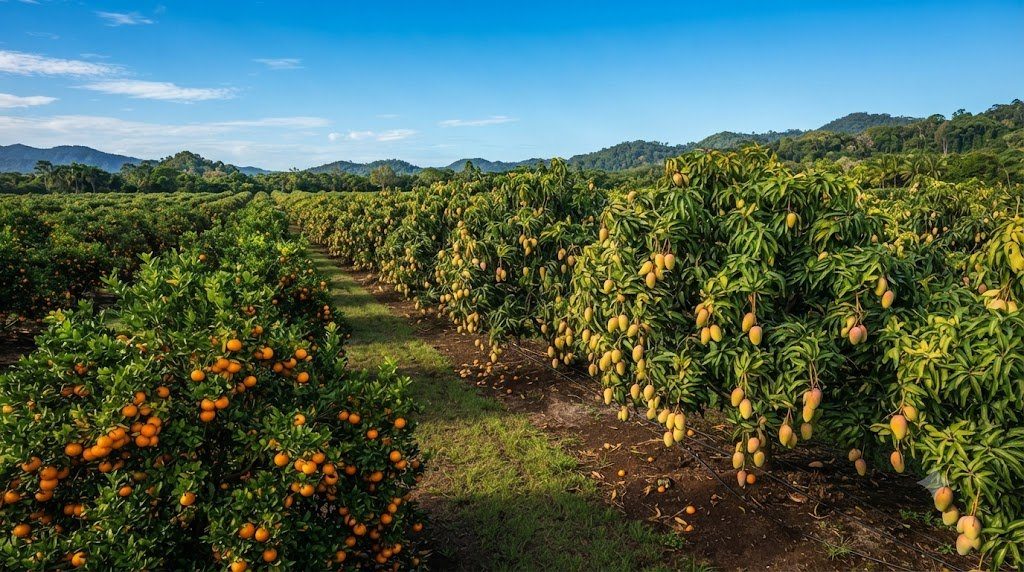
The Sun-Drenched Canopy: Botanical Foundations of Tropical Fruit Trees
Tropical and subtropical pomology represents the vibrant, high-value, and nutritionally rich crown of equatorial agriculture. Among the most culturally revered and commercially exported fruit species across this vast agro-ecological zone are the Mango (Mangifera indica L., Family Anacardiaceae), Citrus species—including Sweet Orange (Citrus sinensis), Mandarin / Tangerine (Citrus reticulata), and Persian/Key Lime (Citrus aurantiifolia / latifolia, Family Rutaceae), and the Guava (Psidium guajava L., Family Myrtaceae). Originating across the humid tropical forests of South Asia, Southeast Asia, and Central America, these evergreen perennial tree crops have diversified into dominant economic engines supporting rural economies and international fresh export trades.
Unlike temperate deciduous fruit trees whose seasonal developmental cycles are strictly governed by winter chilling and daylength, tropical and subtropical evergreen fruit trees operate on fundamentally distinct physiological mechanisms. In these warm-climate species, floral induction, vegetative flushes, and fruit set are governed by Environmental Water Deficits (Soil Moisture Stress), Low Nocturnal Temperatures, and Endogenous Hormonal Balance (chiefly the balance between gibberellins, cytokinins, and ethylene). In commercial orchards, high sustained productivity requires mastering floral regulation, mitigating catastrophic post-bloom physiological fruit drop, eliminating alternate bearing, and safeguarding orchards against devastating biosecurity threats such as Citrus Greening (Huanglongbing – HLB).
In this technical pomological monograph, we examine the shoot maturity requirements for floral induction, deconstruct paclobutrazol anti-gibberellin flower manipulation in mango, model hormonal fruit abscission cascades, analyze crop regulation and meadow orchard systems in guava, detail the pathogenesis of Candidatus Liberibacter asiaticus in citrus, and establish post-harvest vapor heat quarantine protocols.
‘Why do mango trees in tropical climates frequently fail to flower, producing only lush green vegetative leaves? In tropical latitudes lacking cool winter night temperatures, terminal shoots continuously synthesize Gibberellins, which act as potent floral repressors. Applying the triazole plant growth retardant Paclobutrazol (PBZ) as a soil collar drench blocks the ent-kaurene oxidase step of gibberellin biosynthesis. Starved of vegetative gibberellins, dormant terminal buds redirect their carbon assimilates into synthesizing floral panicles—forcing regular, profuse off-season flowering even in stubborn alternate-bearing cultivars!’
Floral Induction Phenology: Low Temperature vs. Water Stress Cues
Evergreen tropical fruit trees utilize distinct environmental signals to transition from vegetative flushes to floral panicles:
- Mango Floral Induction Mechanics: In subtropical regions (e.g., northern India, southern China, Florida), floral induction in mango is triggered by exposure to Cool Night Temperatures (10°C to 15°C / 50°F to 59°F) for a period of 4 to 6 weeks, provided the terminal shoots are physiologically mature (at least 5 to 7 months old with dark green, leathery leaves). In warm, non-seasonal tropical lowlands where temperatures never drop below 20°C, mangoes remain vegetative. Here, growers must induce flowering artificially using chemical foliar sprays of Potassium Nitrate ($KNO_3$ @ 2% to 4%) or soil drenches of paclobutrazol.
- Citrus Floral Induction (The Water Deficit Cue): In citrus, low temperature (below 15°C) can induce floral buds; however, across tropical citrus belts, floral induction is driven primarily by Controlled Soil Moisture Stress (Withholding Irrigation for 4 to 8 Weeks)—a traditional practice known as Bahar Treatment. Moisture stress arrests root and shoot extension growth, triggering the accumulation of proline and floral-promoting transcripts. When the drought-stressed orchard is suddenly re-flooded or irrigated, the trees respond with an explosive, synchronized flush of fragrant white blossoms!
- Guava Crop Regulation (Bahar Induction): Guava flowers and bears fruit on newly emerging current-season vegetative shoots. Left unmanaged, a guava tree flowers continuously throughout the year, producing three distinct seasonal crops (Ambe Bahar in spring, Mrig Bahar in monsoon, and Hasta Bahar in autumn). Because monsoon-ripened fruit is watery, tasteless, and heavily infested with fruit fly maggots, growers execute crop regulation: withholding irrigation in spring and pruning terminal shoots or spraying 10% urea to defoliate the tree, forcing a massive, highly profitable, premium winter harvest (Mrig Bahar) of crisp, sweet fruit!
| Crop Species | Botanical Family | Primary Floral Trigger | Inflorescence Structure | Major Physiological Disorder | Target Commercial Quality |
|---|---|---|---|---|---|
| Mango (Mangifera indica) | Anacardiaceae | Cool night temps (< 15°C) or PBZ | Terminal branched panicle (1,000-5,000 florets) | Alternate bearing; spongy tissue; internal breakdown | High pulp-to-stone ratio, rich aroma, °Brix > 18 |
| Sweet Orange (Citrus sinensis) | Rutaceae | Low temp / Water stress cycle | Solitary or clustered cyme; white perfect | Granulation (Drying of juice vesicles); fruit drop | High juice % (> 45%), TSS:Acid ratio 10:1 to 14:1 |
| Mandarin / Kinnow (Citrus reticulata) | Rutaceae | Winter chilling / Controlled drought | Axillary single or grouped blossoms | Severe alternate bearing; rind puffing & creasing | Easy-peel loose rind, deep orange color, high juice |
| Guava (Psidium guajava) | Myrtaceae | Pruning current-season terminal shoots | Solitary or 2-3 flowered cymes in leaf axils | Fruit fly infestation; bronzing in zinc lack | Crisp white/pink flesh, small seed core, high Vit C |
| Lime / Lemon (Citrus aurantiifolia / limon) | Rutaceae | Continuous flowering modulated by moisture | Axillary and terminal clusters; purple-tinged | Yellowing; premature fruit drop under heat shock | High citric acid content, thin oily aromatic peel |
The Physiological Anatomy of Fruit Drop: The Three Abscission Waves
Tropical fruit trees produce millions of flowers, but mature less than 0.1% to 1.0% into commercial fruit:
- Wave 1: Post-Bloom / Petal Drop Abscission: Occurs within 2 to 3 weeks of flowering. Over 90% of pollinated and unpollinated florets drop off. This initial wave is nature’s self-regulatory cull, eliminating flowers with defective pistils, unfertilized ovules, or poor pollen tube growth.
- Wave 2: The ‘June Drop’ / Pea-Stage Drop: Occurs 4 to 6 weeks after bloom when fruitlets reach marble size. This drop is driven by Intense Carbohydrate and Hormonal Competition between actively expanding fruitlets and vigorous spring vegetative flushes. In the fruitlet pedicel abscission zone, the auxin-to-ethylene balance shifts: auxin flow from the fruitlet slows, sensitizing abscission zone cells to ethylene. Cellulase and polygalacturonase enzymes dissolve the middle lamella, causing healthy green fruitlets to snap and drop.
- Wave 3: Pre-Harvest Drop: Occurs 2 to 4 weeks prior to harvest as fruits approach maturity. Driven by environmental heat stress, soil moisture deficits, or ethylene surges. Pre-harvest drop causes catastrophic economic losses:
Chemical Mitigation: Applying auxinic plant growth regulators—specifically 2,4-Dichlorophenoxyacetic Acid (2,4-D ethyl ester @ 10 to 20 ppm) or Naphthalene Acetic Acid (NAA @ 20 to 40 ppm)—during marble stage and again 4 weeks pre-harvest maintains high basipetal auxin flux across the pedicel abscission zone, preventing middle lamella enzymatic breakdown and slashing pre-harvest fruit drop by 50% to 75%!
Citrus Greening (Huanglongbing – HLB): The Existential Biosecurity Threat
Huanglongbing (HLB), or Yellow Dragon Disease, is the most destructive, catastrophic pathogen affecting global citrus industries:
- Bacterial Etiology and Vector Transmission: Caused by the unculturable, phloem-restricted, Gram-negative alpha-proteobacterium Candidatus Liberibacter asiaticus (CLas). The bacterium is vectorially transmitted from tree to tree by the Asian Citrus Psyllid (Diaphorina citri) during sap-feeding probes on tender young flush foliage.
- Pathogenesis and Symptoms:
- CLas bacteria colonize and multiply inside the phloem sieve tubes, triggering the deposition of callose and p-protein plugs that choke phloem transport.
- Foliage exhibits distinctive Asymmetrical Mottling / Blotchy Mottle: chlorotic yellow patterns that cross leaf veins irregularly (unlike zinc deficiency, which is symmetrical).
- Root systems starve as photosynthates cannot move downward, leading to massive feeder root dieback.
- Fruit remains small, lopsided, and misshapen, with aborted dark seeds. Most characteristically, the fruit fails to color properly, remaining dark olive-green at the stylar end—giving the disease its name ‘Citrus Greening’. The juice becomes intensely bitter, metallic, and commercially undrinkable.
- The Integrated HLB Management Paradigm:
- Plant only certified disease-free budwood produced in screened, insect-proof mother tree repositories.
- Aggressive psyllid vector eradication using coordinated area-wide insecticide sprays (systemic neonicotinoids and pyrethroids) timed precisely to protect new flush growth.
- Strict scouting and prompt removal (pushing and burning) of confirmed infected trees to eliminate field inoculum reservoirs.
- Nutritional canopy therapy: intensive foliar delivery of phosphites, zinc, manganese, and boron to sustain tree vitality and prolong commercial bearing life.
Guava Ultra-High Density Meadow Orcharding Systems
Guava has been transformed from an unruly, sprawling backyard tree into a high-tech industrial plantation crop:
- The Meadow Orchard Architecture: Traditional guava orchards plant trees at 6×6 meters (277 trees/ha) with towering, unmanageable canopies. Modern Meadow Orcharding establishes trees at 2.0 x 1.0 meter or 1.5 x 1.0 meter spacing (3,300 to 5,000 trees per hectare)!
- Topping and Pruning Protocol:
- Young plants are topped at 50 cm height within 3 months of planting to stimulate 3 to 4 strong lateral shoots.
- These primary shoots are subsequently pinched at 30 cm length to produce secondary and tertiary fruiting branches, creating a compact pedestrian hedgerow just 1.5 to 1.8 meters in height.
- Immediately after harvest, the entire hedgerow is mechanically topped and side-pruned, forcing an explosion of new current-season shoots that bear heavy flushes of fruit within 6 months.
- Economic Superiority: Meadow orchards yield 40 to 50 metric tons of fruit per hectare by the second year, compared to traditional orchards that require 6 to 8 years to reach full bearing! Furthermore, 100% of the fruit can be harvested by pickers standing on the ground without ladders.
Mango Malformation and Spongy Tissue Physiological Disorders
Commercial mango orchards face two catastrophic physiological and fungal disorders that undermine profitability:
- Mango Malformation: A complex disorder involving the fungal pathogen Fusarium mangiferae and the bud mite Aceria mangiferae:
- Vegetative Malformation: Apical and axillary buds produce dense bunches of stunted, swollen shoots with minute leaves (‘bunchy top’), halting branch growth.
- Floral Malformation: Floral panicles transform into hypertrophied, compact, green, cauliflower-like masses. Florets fail to open, produce no viable pollen or ovaries, and remain sterile, setting zero fruit!
- Control: Manually prune out and burn malformed panicles 15 cm into healthy wood, followed by spraying a combination of carbendazim and acaricides. Apply NAA @ 100 to 200 ppm in October to suppress malformation initiation.
- Spongy Tissue in Alphonso Mango: A notorious internal physiological breakdown of the mesocarp flesh. The fruit appears completely normal from the outside, but when sliced open, a patch of pulp near the stone is white, pale yellow, spongy, leathery, and acidic, ruining consumer acceptability.
Underlying Mechanism: Caused by Convective Heat Emitted from Bare Soil Surfaces striking the fruit during late maturation, combined with premature starch-to-sugar hydrolysis. Maintaining organic sod or leguminous cover crops on the orchard floor to suppress ground heat reflection, harvesting at 80% maturity (green-ripe stage), and post-harvest calcium dips mitigate spongy tissue incidence.
Post-Harvest Vapor Heat Treatment (VHT) and Cold Quarantine Chains
International fresh fruit export trade is strictly governed by biosecurity quarantine against Tephritid Fruit Flies (Bactrocera dorsalis and B. zonata):
- Vapor Heat Treatment (VHT) Biomechanics: Importing nations (Japan, USA, EU, Australia) mandate that all imported mangoes, papayas, and guavas undergo certified quarantine treatment to eliminate internal fruit fly eggs and larvae without cooking the fruit flesh. In automated VHT chambers, fruit is treated with water-saturated vapor (100% RH) until the Fruit Core Internal Pulp Temperature reaches precisely 46.5°C to 48.0°C (115.7°F to 118.4°F) and is held continuously for 10 to 30 minutes, followed by immediate hydrocooling to 20°C. This hydrothermal treatment guarantees 100% mortality of fruit fly eggs while preserving pericarp luster and pulp sweetness.
- Citrus Cold Quarantine: For citrus exports, fruit is subjected to continuous cold quarantine treatment at 1.1°C to 1.7°C (34°F to 35°F) for 14 to 22 consecutive days inside refrigerated shipping containers to ensure complete destruction of Mediterranean and Oriental fruit fly larvae.
- Post-Harvest Storage Parameters:
- Mangoes: Store mature-green fruit at 12°C to 13°C (54°F to 55°F) with 85% to 90% RH for 2 to 3 weeks. Storing below 10°C triggers severe chilling injury and skin scalding.
- Sweet Oranges & Mandarins: Store at 4°C to 6°C with 90% RH for up to 8 to 12 weeks.
| Cropping Window | Agronomic Focus | Target Practical Action | Primary Commercial Hazard |
|---|---|---|---|
| Post-Harvest Rest | Pruning + Fertilizer application | Prune overlapping branches; apply FYM + balanced NPK | Canopy crowding, fungal anthracnose inoculum build-up |
| Floral Induction | Water stress / PBZ application | Withhold irrigation 4-6 weeks; collar drench PBZ in mango | Vegetative shoot flushes instead of floral panicles |
| Flowering & Fruit Set | Pollination & Anthracnose defense | Spray Azoxystrobin at panicle bloom; avoid insecticidal sprays | Blossom blight rot; poor fruit set from pollinator kill |
| Fruit Swell (Marble) | Fruit drop prevention & Micronutrients | Spray NAA @ 20 ppm + Zinc/Boron foliar chelate | Massive second fruit drop wave losing 60%+ of crop |
| Pre-Harvest & Packing | Fruit fly trapping & VHT certification | Install methyl eugenol traps; execute 48°C VHT chamber cycle | Quarantine rejection and total shipment destruction at export port |
Conclusion: The High-Science Future of Equatorial Pomology
Tropical and subtropical pomology is a vibrant, technologically sophisticated discipline demanding intimate mastery of evergreen plant physiology, environmental floral induction triggers, anti-gibberellin bioregulation, and aggressive quarantine phytosanitary defense. By unlocking synchronized flowering through controlled moisture deficits and paclobutrazol chemistry, suppressing catastrophic fruit drop with precision auxin applications, and engineering high-density meadow architectures, growers harvest breathtaking yields of sun-drenched, luscious fruit.
As international cold chain logistics, molecular breeding, and automated sensor fertigation continue to evolve, tropical orchards will remain the economic lifeblood of agrarian communities and the ultimate providers of natural vitamins and culinary delight across the globe.