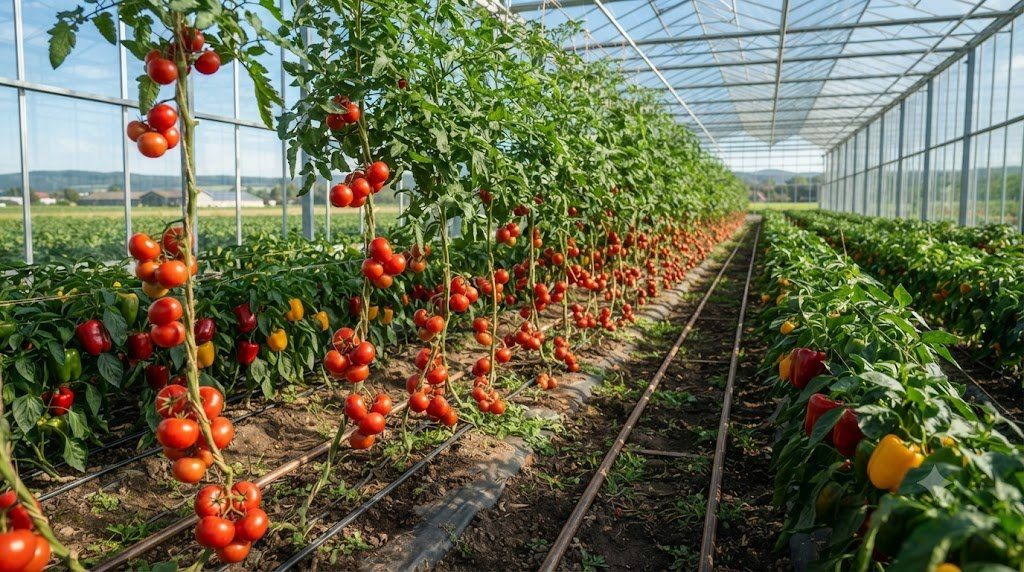
The Royal Nightshades: Botanical Foundations of Family Solanaceae
The nightshade family, Solanaceae, encompasses some of the most economically vital, calorically essential, and nutrient-dense horticultural crops cultivated across global agriculture. Chief among these horticultural titans are tomato (Solanum lycopersicum), sweet and chili pepper (Capsicum annuum, C. chinense, C. baccatum), and eggplant or brinjal (Solanum melongena). Originating primarily in the Andean regions of South America and tropical Mesoamerica (with eggplant originating independently in the tropical valleys of the Indo-Burma region), solanaceous vegetables have diversified into indispensable dietary staples and high-value cash crops in open-field, polyhouse, and high-tech hydroponic CEA (Controlled Environment Agriculture) greenhouses worldwide.
From a botanical and morpho-physiological perspective, these crops are perennial dicotyledonous shrubs cultivated predominantly as warm-season annuals. They possess sympodial shoot growth habits, alternated spiraled foliage, and perfect, hypogynous flowers that produce fleshy, multi-locular botanical berries. However, achieving profitable commercial yields exceeding 100 to 180 metric tons per hectare in tomatoes or 40 to 60 tons per hectare in sweet bell peppers demands rigorous mastery over vegetative-to-reproductive carbohydrate partitioning, precision automated fertigation chemistry, high-wire trellis biomechanics, pollination ecology, and aggressive biosecurity against invasive insect vectors and virulent microbial pathogens.
In this technical agronomic manual, we examine the sympodial branching architecture of indeterminate solanaceous crops, deconstruct calcium mass-flow hydraulics to prevent Blossom End Rot (BER), model automated EC/pH closed-loop drip fertigation recipes, analyze thermal thresholds of pollen viability, detail high-wire trellising and de-leafing regimes, formulate integrated management protocols against Tuta absoluta and Begomoviruses, and outline post-harvest cold chain logistics.
‘In solanaceous fruit crops, Calcium (Ca2+) is strictly an immobile element translocated exclusively through the xylem vessel network via transpiration water pull. Because developing fruits have an exceptionally low transpiration rate compared to broad vegetative foliage, calcium tends to bypass expanding fruits and accumulate in leaves. Under high vapor pressure deficit (VPD) or fluctuating soil moisture, the distal blossom end of the fruit suffers acute localized calcium starvation, causing cellular membrane lysis, ion leakage, and the black sunken necrosis known as Blossom End Rot (BER)!’
Sympodial Architecture: Determinate vs. Indeterminate Physiology
Understanding the architectural morphology of the solanaceous shoot determines pruning, spacing, and trellising regimes:
- Determinate (Bush) Growth Habit (sp/sp Mutation): In determinate cultivars (governed by the recessive self-pruning allele sp), the main stem produces a fixed number of inflorescences (typically 3 to 6). Each vegetative axis terminates in a floral cluster. Shoot elongation halts naturally, resulting in a compact, bushy plant that sets fruit in a concentrated 2-to-3 week flush. Determinate lines are ideal for open-field mechanical harvesting for processing paste, canning, and puree markets.
- Indeterminate Growth Habit (SP+ Wild Type): In indeterminate cultivars, the shoot apical meristem continues vegetative growth indefinitely through a reiterative Sympodial Cycle:
- The main stem produces an inflorescence, after which the vegetative growing point is taken over by the axillary shoot in the leaf axil immediately below the flower cluster.
- This axillary sympodial shoot produces three vegetative leaves, terminates in a new inflorescence, and repeats the cycle indefinitely.
- Under heated glasshouse or tropical greenhouse conditions, indeterminate vines can reach 10 to 15 meters in length, bearing over 30 to 40 successive fruit clusters over a 10-to-12 month continuous harvesting season!
- Semi-Determinate Habits: Intermediate types where apical meristems terminate intermittently, requiring moderate stake support and pruning in fresh-market open fields.
| Crop Species | Growth Habit | Optimal Daytime Temp (°C) | Pollination Mechanism | Primary Commercial Target | Critical Mineral Ratio |
|---|---|---|---|---|---|
| Tomato (Solanum lycopersicum) | Indeterminate / Determinate | 22°C – 26°C | Vibratile (Buzz pollination / Vibration) | High lycopene, firm pericarp, high °Brix (4.5 – 6.5) | K:Ca ratio of 2:1 during heavy fruit load |
| Sweet Bell Pepper (Capsicum annuum) | Dichotomous branching | 24°C – 28°C | Self-pollination + Entomophilous cross | Thick pericarp wall (6-8 mm), blocky 4-lobed shape | High Calcium & Magnesium during cell expansion |
| Chili Pepper (Capsicum frutescens) | Indeterminate shrub | 25°C – 32°C | Self-fertile with high wind/insect assist | High capsaicinoids (SHU), dry matter content | Sulfur & Potassium for oleoresin synthesis |
| Eggplant / Brinjal (Solanum melongena) | Sympodial branching woody shrub | 26°C – 32°C | Heterostyly (Long-styled flowers are fertile) | Glossy anthocyanin skin, minimal seediness | High Potassium to maintain skin luster & firmness |
Precision Drip Fertigation Dynamics and Root-Zone EC/pH Balancing
Modern commercial solanaceous production relies on precision automated drip fertigation, delivering water and dissolved ions directly to the root zone:
- Target Electrical Conductivity (EC) and Osmotic Potential: The electrical conductivity of the delivered nutrient solution governs vegetative versus generative plant steering:
- Vegetative Steering (EC 1.8 to 2.2 dS/m): Used during seedling establishment and early vegetative development. Lower EC reduces osmotic tension, facilitating rapid root uptake and lush shoot growth.
- Generative Steering (EC 2.8 to 3.5 dS/m): Deployed during heavy flowering and fruit maturation. Elevated EC creates mild, controlled osmotic pressure in the root zone, restricting excess foliage expansion and driving photosynthate sugars into developing fruits, elevating total soluble solids (°Brix) and intensifying flavor.
- Strict Root-Zone pH Regulation (pH 5.5 to 6.2): Maintaining root-zone pH within this tight chemical window guarantees complete solubility of micronutrients (Iron-EDDHA, Manganese-EDTA, Zinc, Copper, and Boron). If pH rises above 6.8, phosphorus, iron, and manganese precipitate as insoluble salts, causing interveinal chlorosis; if pH drops below 5.0, calcium and magnesium uptake collapse, and aluminum/manganese toxicities emerge.
- The Nitrogen-Potassium-Calcium Dynamic:
- Vegetative Phase: $N:K_2O$ ratio of 1.0 : 1.2 to support rapid structural biomass and photosynthetic leaf development.
- Fruiting Phase: $N:K_2O$ ratio shifts dramatically to 1.0 : 2.0 to 1.0 : 2.5. Potassium is the primary osmotic engine driving sugar translocation into expanding fruit vacuoles, activating starch synthases, and synthesizing lycopene and anthocyanin pigments.
- Nitrate vs. Ammonium Balance: At least 85% to 90% of total Nitrogen must be delivered in the Nitrate ($NO_3^-$) form! Excessive ammonium ($NH_4^+$) in the root zone competitively inhibits the root absorption of divalent cations ($Ca^{2+}$ and $Mg^{2+}$), directly triggering catastrophic Blossom End Rot.
Calcium Hydraulics and Blossom End Rot (BER) Prevention
Blossom End Rot is a physiological disorder, not a pathogenic disease, caused by localized calcium deficiency in the distal placental tissues of rapidly expanding fruit:
- Xylem Transpiration Biomechanics: Calcium moves almost exclusively in the xylem transpiration stream. Transpiration is driven by vapor pressure deficit (VPD) between the leaf interior and ambient air. Because vegetative leaves possess hundreds of stomata per square millimeter and high transpirational surface area, while green fruits have waxy cuticles with few non-functional stomata, 90% to 95% of absorbed calcium flows directly into the leaves!
- Vapor Pressure Deficit (VPD) Management: Maintaining a greenhouse VPD between 0.8 and 1.2 kPa ensures balanced transpiration. If daytime VPD exceeds 1.5 kPa (extreme dry heat), stomata close or leaves transpire violently, stripping water and calcium away from fruit clusters. If nighttime VPD drops below 0.2 kPa (100% relative humidity), transpiration halts completely, preventing root pressure from pumping calcium into fruit tips.
- Preventative Horticultural Strategies:
- Avoid fluctuating irrigation intervals; maintain uniform substrate volumetric water content (65% to 75%).
- Apply targeted foliar sprays of chelated calcium (Calcium Chloride or Calcium Formate @ 0.2% to 0.3%) directed specifically at young expanding fruitlets within two weeks of petal drop, before fruit cuticular wax thickens and prevents topical absorption.
- Suppress excessive vegetative leaf density through strategic de-leafing, diverting xylem sap flow toward the fruiting trusses.
High-Wire Trellising, Pruning Biomechanics, and Canopy Management
Commercial greenhouse and protected cultivation systems achieve massive productivity through vertical training architecture:
- High-Wire Rollerhook Trellising: Plants are trained vertically along heavy UV-stabilized polypropylene twine suspended from overhead support wires at 4.0 to 5.0 meters height. As the indeterminate vine grows past the wire, growers release twine from a specialized Rollerhook and shift the stem horizontally along lower support brackets (the ‘leaning and lowering’ technique). The lower, bare harvested stem rests horizontally along the ground or pipe-rail trolleys, keeping the active flowering and fruiting canopy in the optimal light interception zone.
- Side-Shoot De-Suckering (Pruning): In indeterminate tomatoes and eggplants, axillary vegetative shoots (‘suckers’) emerge at every leaf node. Pruning crews must remove these suckers manually when they are 2 to 5 cm long, directing 100% of carbon assimilate into the primary central leader. Snapping suckers cleanly with gloved fingers prevents sap transmission of contact viruses (such as Tobacco Mosaic Virus).
- De-Leafing and Airflow Optimization: As lower fruit trusses mature and are harvested, all vegetative leaves beneath the lowest ripening cluster are cleanly excised. Removing 3 to 4 lower senescent leaves per week eliminates non-productive respiratory carbon sinks, removes aging leaves harboring fungal spores, and opens up the lower canopy to air circulation, slashing relative humidity and preventing grey mold (Botrytis cinerea).
- Truss Pruning for Fruit Uniformity: To ensure premium size grading, indeterminate tomato clusters are pruned to a uniform fruit count: large beefsteak cultivars are pruned to 3 to 4 fruits per truss, while round cluster/truss tomatoes are pruned to 5 to 6 fruits.
Floral Biology, Pollination Ecology, and Heat Sterility
Solanaceous flowers require specific physical stimuli to achieve high-percentage fruit set:
- Vibratile (Poricidal) Anther Dehiscence: Tomato and eggplant anthers form a tight conical tube enclosing the pistil. Unlike open flowers whose pollen is exposed to wind, solanaceous anthers dehisce through minute pores or longitudinal slits located only at the tip. Releasing pollen requires mechanical vibration at a specific sonic frequency (approximately 300 to 400 Hz)—a phenomenon known as Buzz Pollination.
- Bumblebee (Bombus terrestris / B. impatiens) Deployment: Commercial protected agriculture utilizes commercially reared colonies of bumblebees. Bumblebees grasp the floral cone with their mandibles and contract their flight muscles violently without moving their wings, producing a characteristic high-pitched buzz that ejects a cloud of electrostatic pollen onto their bodies and directly onto the receptive stigma. Bumblebees leave a distinct brown bruise on the floral cone (‘bee mark’), allowing growers to audit pollination efficacy (aiming for > 95% bee marks).
- Thermal Pollen Sterility: Solanaceous pollen is acutely vulnerable to heat shock. When daytime temperatures exceed 32°C to 35°C (90°F to 95°F), or night temperatures remain above 22°C:
- Tapetal cells in the anther fail to supply carbohydrates to developing microspores.
- Pollen grains become sterile and fail to germinate on the stigma.
- Style elongation occurs (heterostyly / exerted stigma), pushing the stigma out beyond the protective anther cone where it desiccates in dry ambient air, resulting in massive blossom drop!
Integrated Pest and Vector Management: Tuta absoluta and Whiteflies
Protecting high-value solanaceous canopies demands relentless biological and chemical pest management:
- Tomato Leafminer (Tuta absoluta): The most devastating invasive lepidopteran pest of tomatoes worldwide. Caterpillars mine inside the leaf mesophyll, creating translucent irregular blotch mines that turn brown and necrotic. Larvae also burrow directly into green and ripe fruits, leaving circular exit holes ringed with black frass, inviting secondary bacterial soft rots.
Management Protocol:
- Install pheromone delta traps (30 to 40 traps/ha) for mass-trapping and mating disruption.
- Release predatory mirid bugs (Nesidiocoris tenuis or Macrolophus pygmaeus) early in the crop cycle; these voracious predators consume up to 30 to 50 Tuta eggs per day.
- Apply targeted biorational chemistries including emamectin benzoate, spinetoram, or chlorantraniliprole, rotating IRAC modes of action to prevent insecticide resistance.
- Silverleaf Whitefly (Bemisia tabaci) and Begomoviruses: Whiteflies suck phloem sap, excrete honeydew that fuels black sooty mold, and transmit devastating viruses including Tomato Yellow Leaf Curl Virus (TYLCV) and Chili Leaf Curl Virus (ChiLCV). Deploy yellow sticky rolls along greenhouse perimeters, maintain insect-proof netting (50-mesh screens), and apply systemic diamides or spirotetramat at first detection.
- Bacterial Wilt (Ralstonia solanacearum): A deadly soil-borne pathogen causing rapid vascular wilt without initial foliar yellowing. Stem cross-sections suspended in clear water exhibit milky white streaming of bacterial ooze. Control requires grafting elite scions onto resistant wild rootstocks (such as Solanum torvum for eggplant or Maxifort for tomato).
Post-Harvest Physiology, Ethylene Kinetics, and Cold Storage Logistics
Maintaining post-harvest firmness and shelf life requires understanding fruit ripening biochemistry:
- Climacteric (Tomato) vs. Non-Climacteric (Pepper, Eggplant) Maturation:
- Tomato: A classic climacteric fruit exhibiting a sharp respiratory burst accompanied by a surge in endogenous Ethylene ($C_2H_4$) production during ripening. Tomatoes can be harvested at the mature-green or breaker stage (first appearance of pink color at the blossom end) and ripened under controlled post-harvest conditions using exogenous ethylene gas (100 to 150 ppm at 20°C).
- Peppers and Eggplants: Non-climacteric fruits that produce negligible ethylene and do not undergo a post-harvest ripening surge. They must be harvested fully mature on the vine when firm, crisp, and fully colored.
- Chilling Injury Vulnerability: Solanaceous vegetables are warm-season crops acutely sensitive to low temperatures:
- Never store tomatoes, peppers, or eggplants below 10°C to 12°C (50°F to 54°F)!
- Storing ripe or mature fruits in typical 4°C household refrigerators causes Chilling Injury: cellular membrane phase transitions from fluid to rigid gel, breakdown of lycopene synthesis, surface pitting, water-soaked calyx decay, and total loss of aromatic flavor volatiles!
- Commercial Storage Parameters: Optimal storage for ripe tomatoes and peppers is 12°C to 15°C (54°F to 59°F) with 85% to 90% relative humidity, preserving cellular turgor, pericarp crispness, and market gloss for 14 to 21 days.
| Operational Milestone | Technical Specification | Best Management Practice | Primary Economic Risk |
|---|---|---|---|
| Transplant Establishment | 35-40 day nursery plugs; 4-5 true leaves | Transplant onto raised plastic-mulched beds with drip | Pythium damping off, root transplant shock |
| Nutrient Delivery | Automated injection; EC 2.2-2.8, pH 5.8-6.2 | High Nitrate-N; elevate Potassium during fruit swell | Blossom End Rot, ammonium toxicity, micronutrient lockout |
| Canopy Architecture | High-wire rollerhooks; weekly de-suckering | Remove lateral shoots at 2-3 cm; de-leaf lower canopy | Overgrown dense canopy, grey mold rot, micro-fruit size |
| Fruit Set & Pollination | Deploy Bombus bumblebee hives @ 2-3 hives/ha | Maintain greenhouse temps strictly between 18°C and 30°C | Pollen sterility, catastrophic flower drop, catfacing |
| Post-Harvest Handling | Harvest at breaker stage; store at 12°C – 15°C | Rapid forced-air precooling; maintain 85-90% RH | Chilling injury, water loss, calyx browning, mold |
Conclusion: The High-Precision Horizon of Solanaceous Horticulture
Solanaceous crop production represents the modern zenith of scientific horticulture, integrating advanced genetics, plant physiology, biomechanical trellis engineering, and automated closed-loop fertigation chemistry. By balancing vegetative-reproductive growth through electrical conductivity manipulation, safeguarding fruit calcium flux against transpirational bypass, utilizing natural bumblebee pollinators, and implementing aggressive multi-trophic biocontrol, commercial growers achieve unprecedented yields and exquisite nutritional quality.
As sensor-driven vertical farming, robotics, and genomic editing continue to redefine vegetable agronomy, the humble nightshades will remain at the forefront of global nutritional security and high-value agricultural economics.